
Chronic stress is a ‘widespread issue affecting health systems worldwide’, according to a new report.
The report, titled ‘Chronic stress: Are we reaching health system burn out?’, was released in November 2019 by Asia Care Group.
It assessed the impact of stress on health systems across Australia, Hong Kong, Malaysia, Singapore, South Korea, Taiwan, Thailand, United Arab Emirates, United Kingdom, and the US, and revealed some significant findings.
Stress Care Study Results
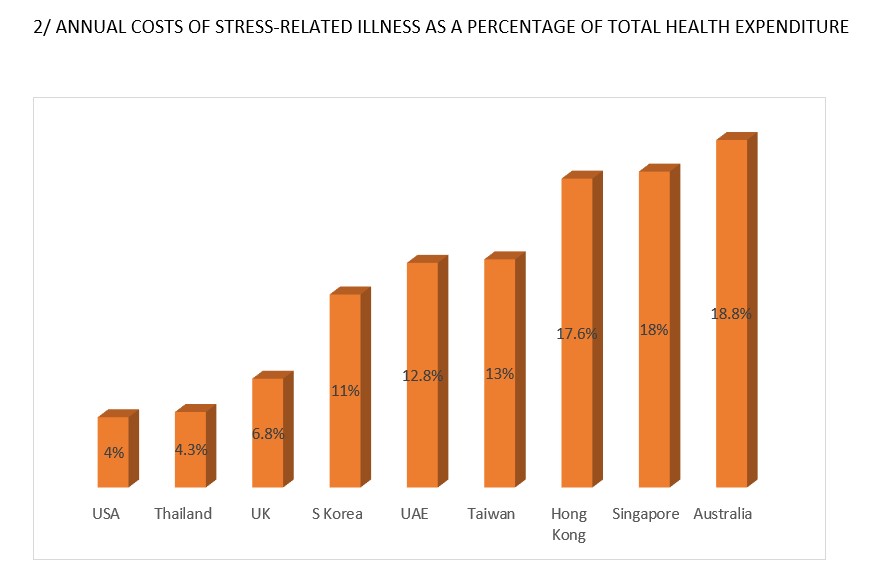
- Between 4% and 19% of health expenditure is attributable to stress-related illness
- 25% of hospital admissions with underlying stress driver
- 35% of primary care attendances with underlying stress driver
- 19% of emergency department attendances with underlying stress driver
- 12% of outpatient attendances with underlying stress driver
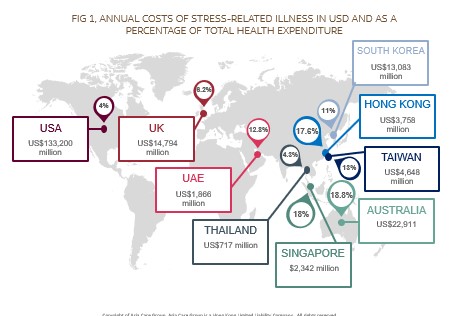
The report concluded that between 4% and 19% of health expenditure is attributable to stress-related illness. This amounts to between US$717million and US$133.2billion annually.
Figure 1 - Annual costs of stress-related illnesses
Huge financial burden
In the foreword for the report, Jason Sadler, President of Cigna International Markets pointed out that Cigna’s latest Global Well-Being Survey found that 84% of the world population suffers from stress.
He stated that the findings from the Cigna survey were “even more alarming” in Asia where “91% reported that they are stressed and as many as eight out of 10 people saying they operate in an ‘always on’ culture”.
Jason went on to state that the new report from Asia Care Group “highlights the huge financial burden that stress-related illness is putting on health systems worldwide”.
“While many people recognise the immediate symptoms of stress, what is less understood is how it can manifest itself in physical manifestations in the body including chest pain, circulatory problems, gastrointestinal problems, musculoskeletal pain (MSK), and women’s health issues.”
“In many instances, people are trying to find cures to the symptoms of chronic stress, without recognising the root cause.”
He added: “Although stress will always exist, we believe that through better awareness, response and diagnosis we can help people to live happier, more productive lives, reduce physical illnesses and avoid these significant misdirected costs on our health systems worldwide.”
Figure 2 - Annual costs of stress-related illnesses as a percentage of total health expenditure
We need urgent action
The report found that there was “considerable variability” across the health systems in different markets, but that the overall issue of stress translated to “one of the largest single areas of spend facing health systems today”.
“The impact of stress is placing an added burden on health systems at a time when they are already overstretched, and costs are expected to continue to rise.
“Not only is chronic stress strongly associated with mental health issues like anxiety, panic attacks and depression, but it can manifest in physical symptoms.”
The report examined three patient cohorts which each “accounted for a considerable percentage of health expenditure”.
1) “Those who sought help for stress related mental ill-health;
2) “Those suffering from stress-related illness and sought help for a physical issue that was deemed to have an ‘unexplained medical condition’;
3) “Those who sought care for physical symptoms that are commonly associated with stress, such as IBS or lower-back pain, but also had underlying mental ill-health associated with stress.”
Report’s key findings
The report revealed that in all nine markets as much as 25% of hospital admissions, 35% of emergency department attendances, 19% of primary care visits, and 12% of outpatient attendances are likely to be the result of stress-related illness.
The report went on to state: “The findings of this study clearly indicate there a need for urgent action to address the causes of stress, support people to manage stress better and to ensure systems are in place to identify and treat stress-related illness and its causes.”
Report’s key recommendations
Helping prevent stress-related illness
- “Healthcare leaders should develop social marketing campaigns to help populations recognise the signs and symptoms of stress-related illness.”
Monitoring and evaluating the health system
- “Healthcare leaders should ensure there are robust mechanisms to record a patient’s diagnosis across care settings based on international norms. This would allow greater transparency on the use of health systems by those suffering from stress-related illness.”
Ensuring effective treatment and recovery for those who do suffer from stress-related illness
- “Healthcare leaders should encourage more training of physicians in detecting, diagnosing and managing stress-related illness – particularly for those working in primary care and emergency care.”
The report's executive summary is available here.
Cigna’s view
Ryan O’Donovan, Managing Director of Cigna Global IPMI, said the report “clearly shows the negative impact that chronic stress is having”.
“As this report from Asia Care Group states, stress is a widespread issue that needs to be looked at urgently. Here at Cigna, we’re aiming to address the issue of stress head on.
“We want to increase awareness about the negative effects of stress and adopt a more open approach to healthcare to address both the physical and mental wellbeing of the individual. This is an approach that we like to call ‘whole person health.’”
He added: “We want to draw attention to the fact that stress not only has emotional effects, but physical ones too.”
See Stress Differently

Cigna’s work is rooted in our mission to improve the health, well-being and peace of mind of those we serve. Using cutting-edge technology and through our work partnering with doctors, technologists and artists, Cigna has come up with a powerful new way to make the invisible visible.
Introducing our transformative new initiative - ‘See Stress Differently’.
Take our stress test
Our doctors have devised a short stress test, based on an established industry standard: the Perceived Stress Scale.
The test only takes three-minutes to complete and you can take it here.
Be sure to share your test results with us on social media by using the tag #SeeStressDifferently.
For more information about our initiative, please visit: https://bit.ly/2Wy5chr.
Asia Care Group
Asia Care Group are a specialist management consulting firm that advise healthcare organisations on strategy and change. They work across the industry - with Governments, Payors, Providers and a range of development organisations - to help create sustainable systems across Asia-Pacific.
Sources: 2019 Cigna 360 Well-Being Survey – https://wellbeing.cigna.com/360Survey_Report.pdf